
Amazon · 2020 → 2022 · Learning Experience Architect
Equipped to Thrive
Scrappy Toolkit to Leadership Journey
- 8,785 unique uses of the EtT toolkit
- 4.6★ average rating
- 80 NPS
- 94% of workshop participants reported a stronger understanding of EQ and effective leadership
Watch the program
Context
I joined Amazon as a Senior Instructional Designer not long after the spring 2020 lockdowns. Employee morale was low, and my Director was flagging a sharp, specific need: leaders needed real support having difficult conversations in the middle of the pandemic. Nothing inside Amazon existed to help with that.
My first assignment was to partner with Rich Hau — a passionate Amazonian who was building the case for a full EQ wellness program, and who went on to serve as Amazon’s Chief EQ Officer for several years. His plans were big and rigorous; I made a different call. People needed something now, something simple to consume, in a language Amazonians would actually use.
That’s where Equipped to Thrive came in: a portal of practical tips, framed in Amazon’s vocabulary, that managers and ICs could pick up between meetings.
The bet was deliberate. Amazon has always been a high-performance culture, and at the time wellbeing wasn’t part of the equation. EtT was designed as a low-cost test to prove the need — a two-way-door experiment. If the portal didn’t get traction, we’d close the door. If it did, we’d have the data to make the case for deeper investment.
The portal became the most-visited resource our team owned. That data later built the case for EPIC — Rich’s flagship EQ program — and, two years on, for Lead to Thrive.
Designing the toolkit
The constraints were tight. Ship fast. No budget for an extensive learning needs analysis. No live workshops — too high-cost for a first move. And a skeptical audience that didn’t think wellbeing belonged at work in the first place. What I had was customer empathy and a clear hypothesis about what Amazonians needed now.
Translating EQ into Amazon’s language
Amazon has a distinctive, no-frills communication style — people there speak in data, optimization, and mechanisms. Soft skills land badly in that register. So I took Daniel Goleman’s Emotional Intelligence, the canonical reference for EQ, and translated it into Amazon’s vocabulary, mapping each EQ skill to Amazon’s Leadership Principles. The content talked about self-awareness, regulation, empathy, and social skill the way Amazonians talked about ownership, bias for action, and customer obsession: scientific, evidence-based, framed as performance levers for a skeptical technical audience.
A portal, not a program
The deliverable was a self-serve portal: practical tips, articles, a self-assessment quiz, guided meditations, and a buddy-system model for peer support. Content people could pick up between meetings, share with a teammate, or send to a manager after a rough call. No course signup. No manager permission. That was the point.
The design call I’m proudest of
Customer empathy drove every decision. Where are people right now? What do they need most? What can they actually use today, between Slack messages and standups? I wasn’t designing a curriculum — I was designing for a moment in someone’s worst week. That framing kept the work honest, and it kept me from over-building.
From toolkit to program: Lead to Thrive
EtT shipped, found its audience, and went on doing its job. I moved on to other work. The two-year gap was useful: it gave me time to gather signal on which content was getting picked up, what was being shared, where managers were getting stuck. At the end of the first year I ran an evaluation of the toolkit’s impact and wrote a proposal to extend it.
The case made itself in the numbers. EtT had proven the appetite — but there was a gap in the ecosystem. EtT sat at the simple, self-serve end: a toolkit you could pick up between meetings. EPIC, the flagship EQ program, sat at the formal, intensive end. There was nothing in between — no structured program that could take a leader from a quick tip to lasting mastery. Lead to Thrive was designed to bridge that gap.
The design shift: from tips to lasting behavior change
EtT was the tip of the iceberg — high-level tips and resources for people who needed something now. Lead to Thrive was built underneath it: a flexible learning journey designed for deeper mastery and durable change.
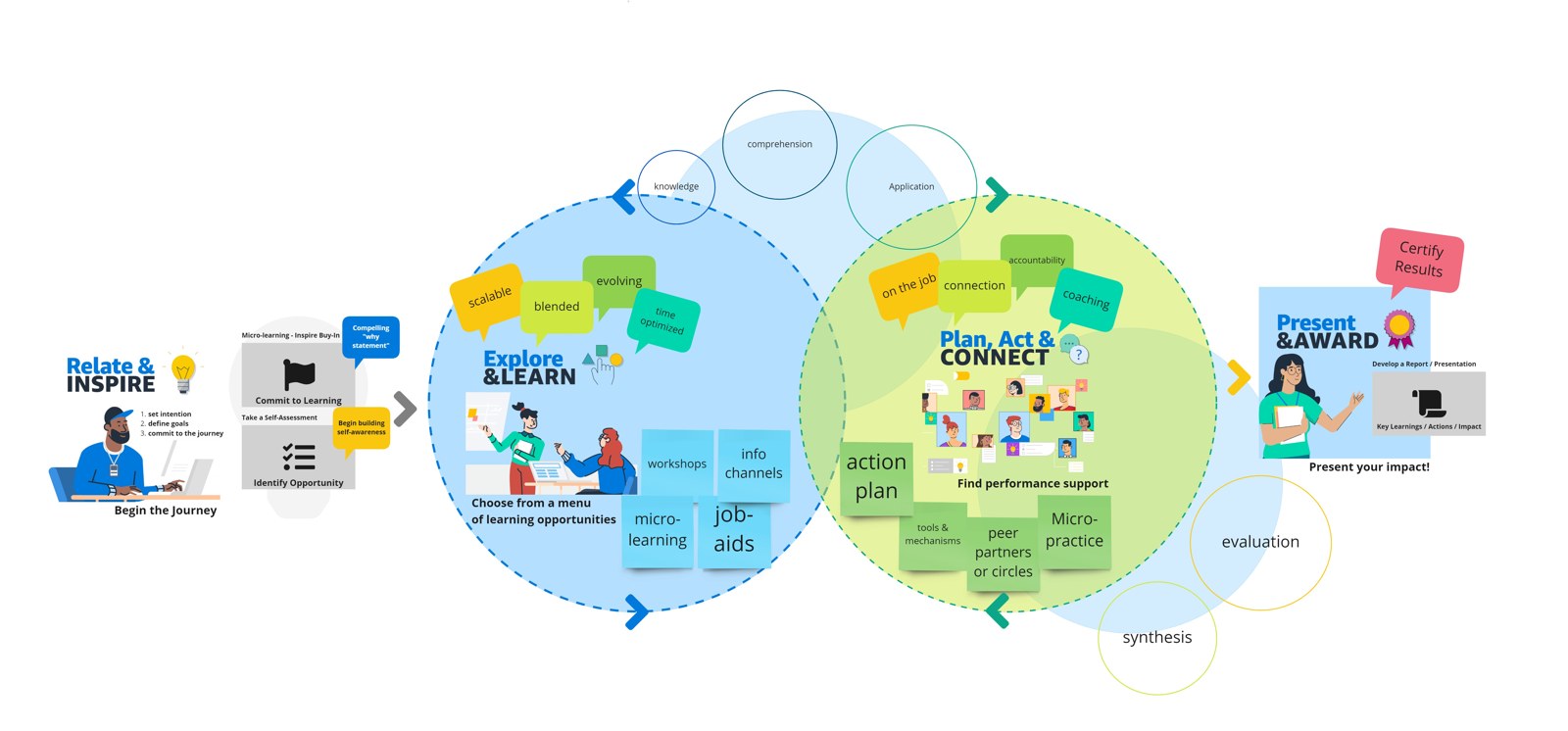
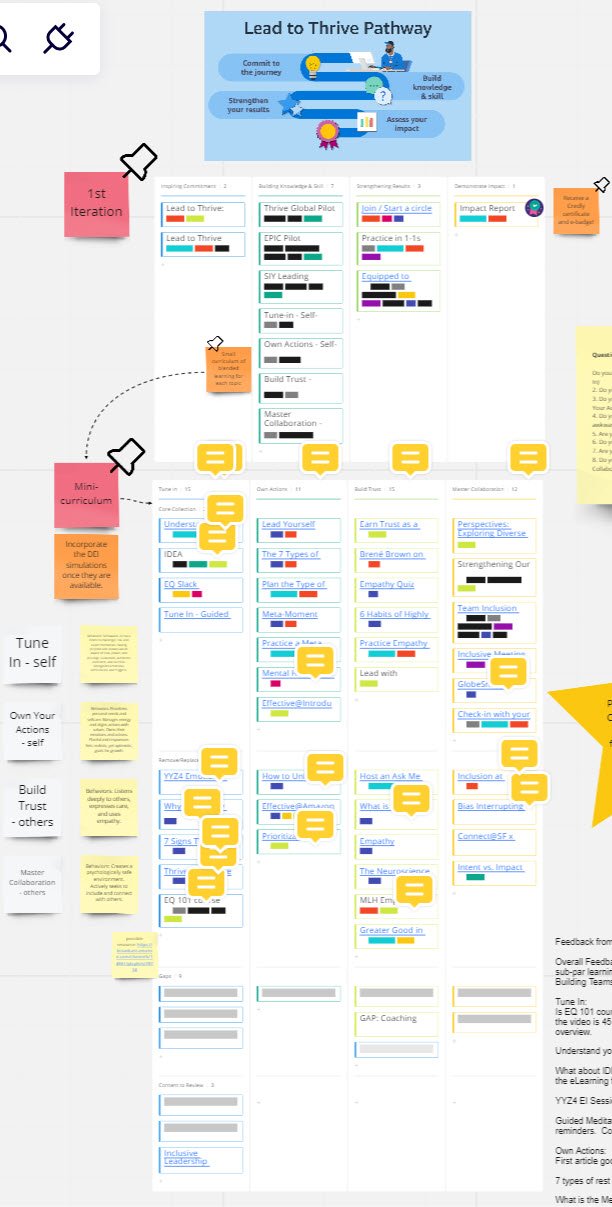
The journey runs through four phases — Relate & Inspire, Explore & Learn, Plan, Act & Connect, and Present & Award — and supports four competency tracks: Inspiring Commitment, Building Knowledge & Skill, Strengthening Results, and Demonstrate Impact. Learners move through the pathway flexibly, surfacing the modules that fit their context rather than marching through a fixed curriculum.
Badging that meant something
LtT was the first leadership program in Devices and Services to issue a public-facing credential through Credly. Historically, only technical learning was certified — leadership development was treated as soft, informal, ungraded. Putting a public badge on leadership competency was a deliberate move to give it the same credibility as a technical certification. If you completed the journey, you could show it.
Outcomes
The number that mattered most wasn’t the launch spike. After the first surge, EtT’s usage held steady and then grew, year over year — picked up by other parts of the company, including AWS. EtT didn’t end up as a forgotten wiki page; it became something teams actually returned to.
The diagnostic quiz did real work
The piece I’m proudest of from EtT is the diagnostic quiz at the heart of the portal. It was a scrappy build — no engineering budget, no purpose-built assessment platform — but it gave learners a personal entry point into the content. Instead of facing a flat library of articles, you got a snapshot of where you were across the EQ dimensions and a curated set of next steps from there. It elevated what was technically a static portal into something that felt personal and adaptive.
“I think the quiz is a tool that I can take and use to help my team develop and understand their team mates. Should definitely foster a better working relationship within the team.”Amazon manager, EtT feedback
Lead to Thrive launched into early workshops with strong signal — leaders reporting a stronger grasp of how emotional intelligence connects to effective leadership. The program scaled after I left Amazon, so I don’t have its long-tail metrics. What I can speak to is the design itself: an EtT toolkit that kept compounding for years, and a program built on top of it that gave leadership development the same credibility the company had always given technical skill.
What I learned
The biggest lesson from this work: a fast experiment, aimed at the right need, can turn into something much bigger. Learning design doesn’t have to follow the traditional waterfall path. A scrappy prototype shipped at the right moment can do more for an organization than a rigorously planned curriculum that lands a year too late.
What I’d change about LtT: the launch. A soft launch was the wrong tool for a journey-based program with a credential at the end — it didn’t generate enough momentum for learners to progress through the full pathway and earn the badge. A targeted, org-sponsored kickoff event would have given the program a clearer starting point and turned the badge into a near-term goal instead of something distant.
The through-line, and the way I work in general: I focus on the customer first — always. When there isn’t time for the full data-gathering cycle, I find the answer through experimentation and iteration. EtT was that approach in its purest form: a small, honest bet placed exactly when people needed something. The bet earned the right to become a program.