
Salesforce · 2024 – 2025 · Leadership Program Manager
EMpact
Adaptive Leadership Development for Engineering Managers
- 450+ participants across the Americas & India
- 97% participant satisfaction
- 19–33% lift across four leadership competencies
- 93% reported sustained mindset or behavior change at 3 months
Context
Engineering Managers at Salesforce sit in an unusually layered role. They’re accountable for shipping at speed and meeting Trust standards, while simultaneously growing, mentoring, and managing the performance of teams undergoing active technological transformation.
I led extensive listening sessions with stakeholders and SMEs across the organization, which surfaced a clear gap: no training existed to help engineering managers navigate the ambiguous, day-to-day tradeoffs between technical delivery and people leadership — and no structured way for them to build the cross-team peer networks they relied on as support.
EMpact was built specifically for that role, and that gap.
The mechanic
Most leadership simulations script the scenarios in advance: present a vignette, prompt a response, reveal a predetermined outcome. That works for content delivery, but it fails to mirror reality — where decisions cascade unpredictably and there’s no answer key.
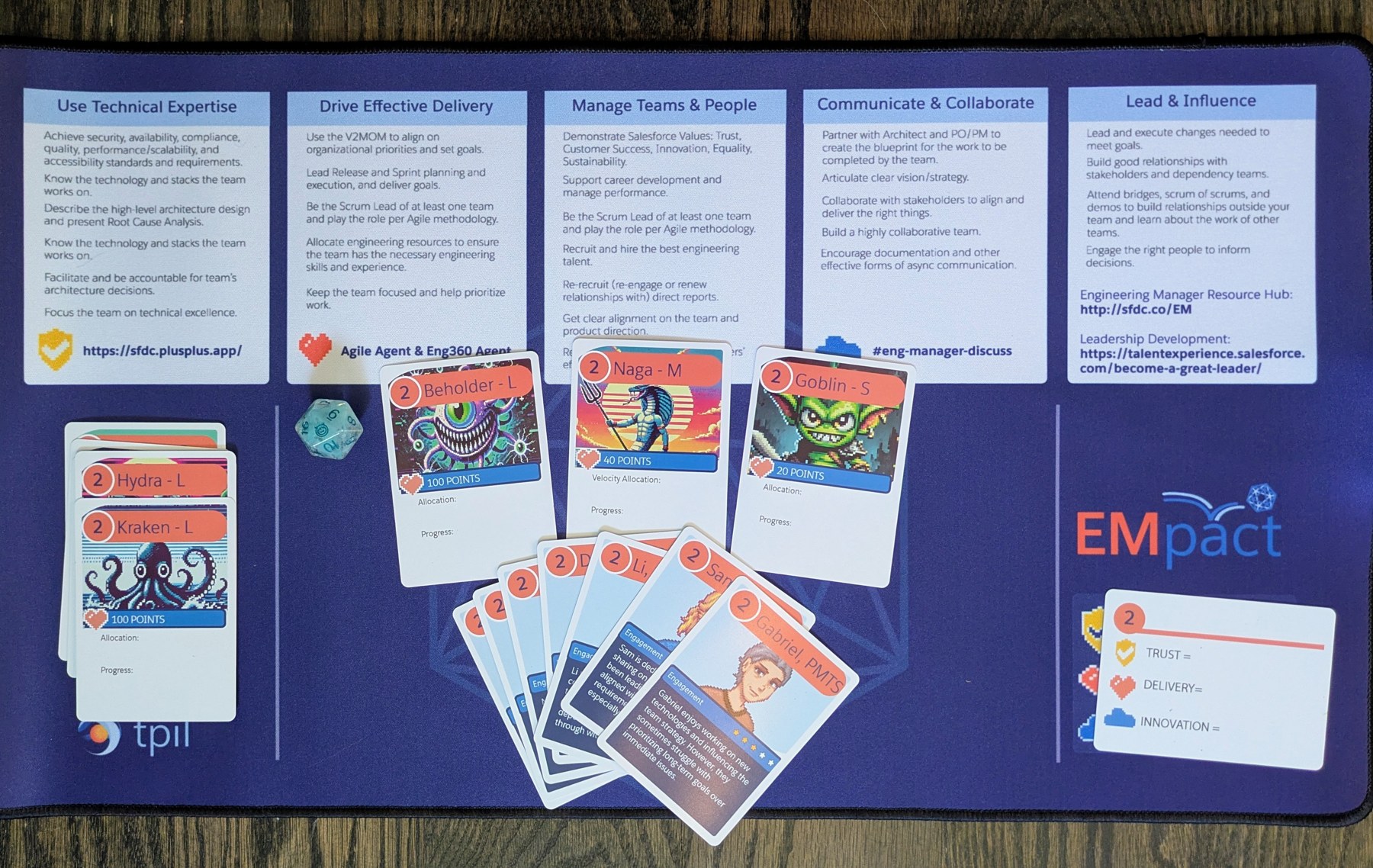
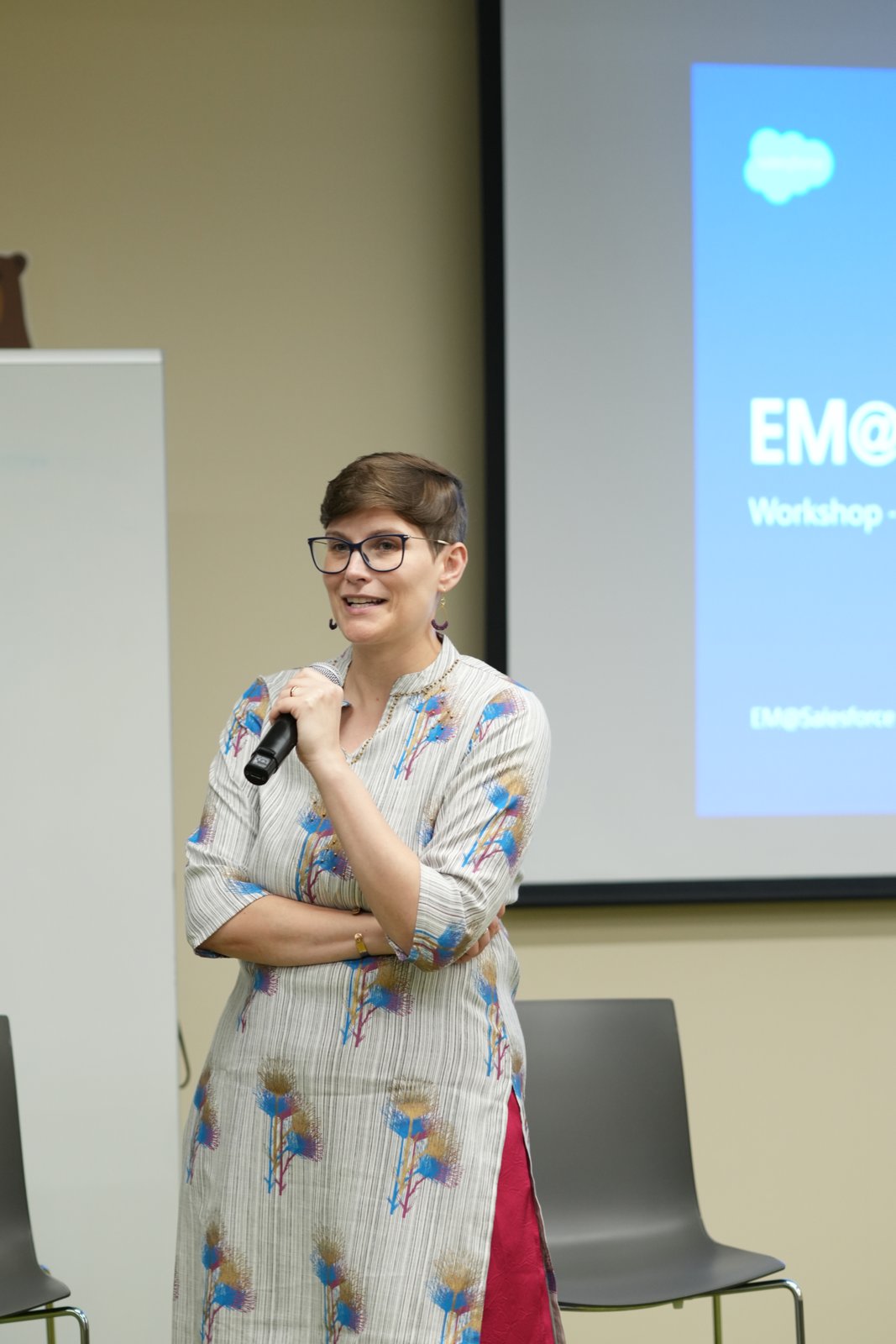
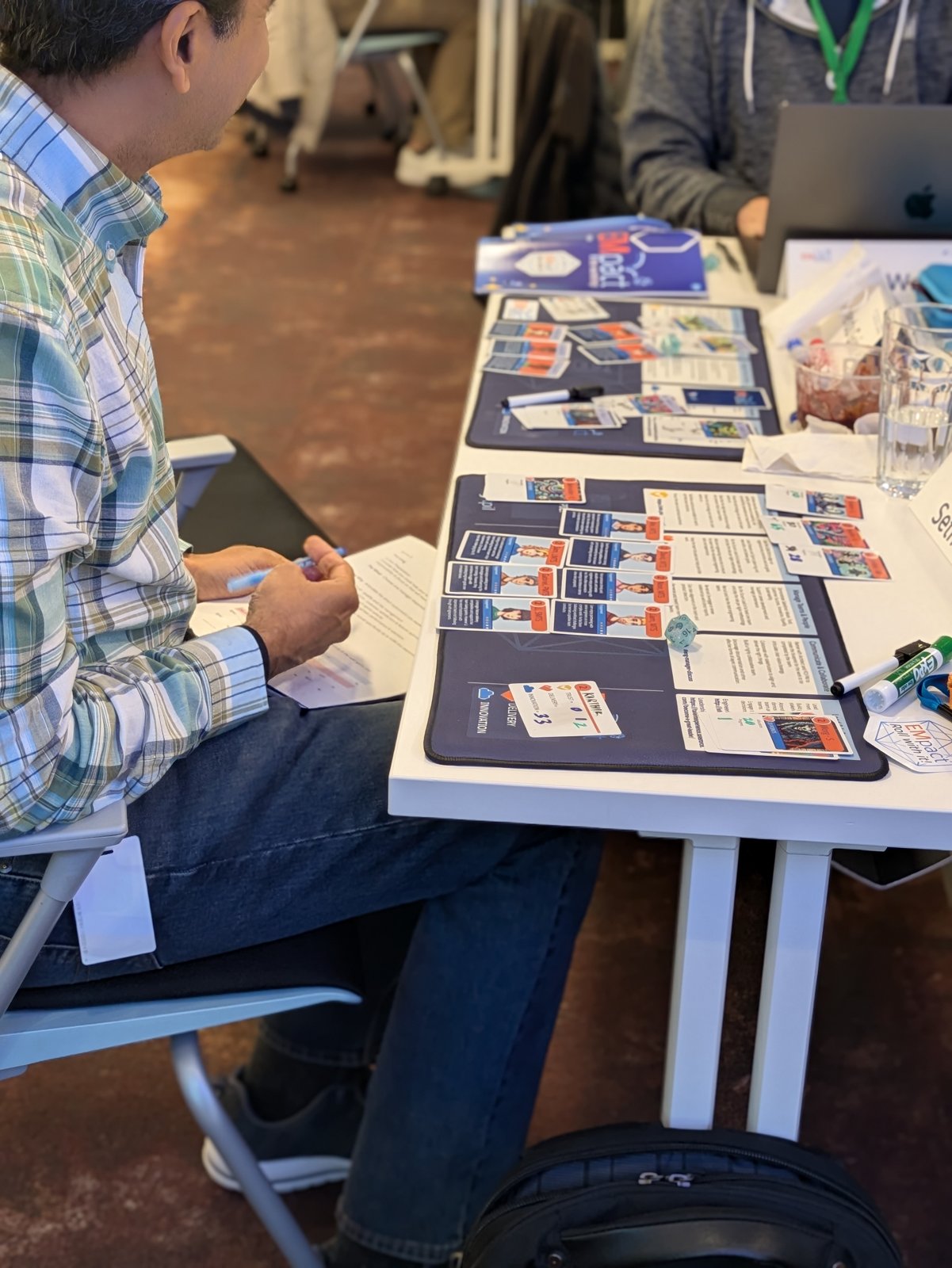
I modeled EMpact’s simulation on tabletop role-playing, specifically Dungeons & Dragons. Instead of pre-built scenarios, senior leaders take on the role of Directing Managers (“DMs”), guiding a small group of engineering managers through a six-sprint release. The DMs introduce real-world disruptions and respond dynamically to each decision — participants think on their feet, see the ripple effects of their choices, and (importantly) have fun while developing leadership skills and cross-team relationships.
The workshop is built from four modular components: facilitated problem-solving on “top of mind” challenges sourced from incoming participants, the simulation itself, a candid executive Q&A, and an in-depth technical session. That modularity is what lets the program evolve year over year — 2025’s focus on data-driven decisions can shift to 2026’s emphasis on AI-augmented teams without redesigning the core.
A second-order effect: the Directing Managers benefit as much as the participants. Stepping into the DM role flexes business judgment, builds coaching and mentorship muscles, and gives senior leaders visibility into challenges across the organization.
Delivery & iteration
Sponsors asked for progress over perfection, so I ran an agile delivery cadence: an alpha test in February 2025, two beta pilots in March (Seattle and Hyderabad), two gold pilots in June (San Francisco and Bangalore), and an official launch in July. After each pilot, I refined design and content from survey data and participant interviews. Satisfaction climbed from 80% to 97% across pilots, and feedback shifted from constructive critique to “unlike any training I’ve taken.”
Three problems shaped the design between pilots.
Simulation complexity
Early pilots revealed that the game mechanics created confusion that distracted from the learning. Over four pilots I systematically simplified the D&D-inspired model — including building a simulation tracker in Google Sheets rather than a custom app. The Sheets approach was deliberate: accessible to facilitators, flexible to change, and free of engineering dependencies. I also set an experience floor (six months in role) so newer managers built foundational skills before joining an intensive workshop.
Directing Manager quality
A clear pattern emerged: the DM makes or breaks the participant experience. Early workshops relied on volunteer senior leaders with uneven preparation. Rather than asking less of them, I built a dedicated faculty model — 25 senior leaders across the US and India, selected for coaching strengths and DM enthusiasm, traveling with the lead facilitator. The role is positioned as leadership development for the DMs themselves. The first three workshops under this model, delivered in the past two weeks, have significantly improved the participant experience.
Demand management
The executive target was 600 engineering managers in year one; we delivered seven workshops across four hubs and served 450+ participants. Early adopters enrolled fast, but most managers hesitated to commit two full days to an unproven workshop. Instead of treating that as failure, I moved to a demand-driven model: fewer workshops initially, expansion only when waitlists are consistent, and broader eligibility for remote and global EMs outside the main hubs.
The through-line: build the test-and-learn cycle into the program structure itself, so the program keeps improving in production rather than being frozen at launch.
Outcomes
EMpact exceeded every objective set for year one, with impact sustained well past the workshop itself.
Year-one program performance (450+ participants, Americas & India)
- 97% satisfaction (target: 80%)
- +33% confidence in building peer connections across teams
- +28% confidence in navigating tradeoffs between competing responsibilities
- +21% confidence in using data to improve team performance and customer trust
- +19% confidence in managing disruptive situations
Three-month follow-up research with 31 participants
- 93% reported sustained shifts in mindset or behavior
- 87% said the program helped them manage ambiguity in real-world situations
- 84% reported improved tradeoff management
- 75% were actively applying data-driven decision-making
The follow-up numbers mattered most to me: the program’s real value was whether it changed how people led after they left the room. It did. One engineering manager negotiated through a project cancellation affecting 13 engineers a week before a major company event, using workshop frameworks to retain team members and reframe the team’s scope. Another reduced defects to “basically zero” by using data to prioritize the work that prevents future issues.
“I really feel that this training prepped me for what was coming up. I feel prepared.”Engineering Manager, three-month follow-up
The 33% lift in peer connections also created something I hadn’t planned for: lasting informal support networks. Participants reported continuing to reach out to workshop peers for advice on challenges — extending the program’s impact well beyond the two-day experience.
What’s next
The next chapter has now shipped. Across three workshops in Seattle, San Francisco, and Hyderabad, I rolled out 14 new disruption scenarios built around AI-team dynamics. The new content landed: DMs came in well-prepared — the faculty model is paying off — and partnered actively with me through the experience.
One experiment came out of those workshops: I built a Claude-powered front-end dashboard for the sprint tracker and tested it live, using it to facilitate the retrospectives. It worked.
The real “what’s next” is one layer deeper. Today the engineering teams in the simulation are traditional Scrum teams — humans only. The next iteration depicts an AI-native team, where engineering managers learn to orchestrate the collaboration between human engineers and AI teammates rather than lead a human-only team through change.
The modular architecture is what makes that kind of evolution possible. The core framework — immersive simulation, peer connection, leader coaching — stays constant while the scenarios and technical content adapt. EMpact isn’t a one-time training event; it’s a platform that grows with the engineering org through each phase of transformation.